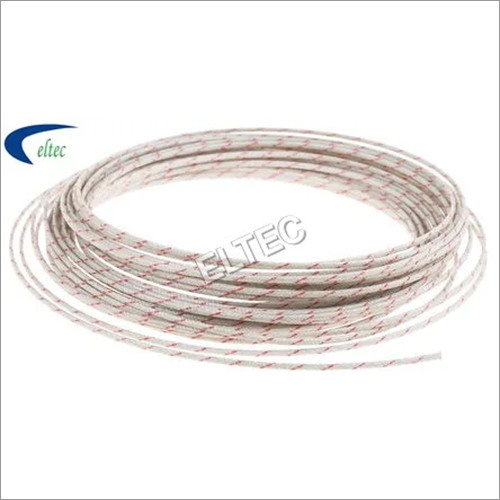
J TYPE FIBER GLASS THERMOCOUPLE WIRE About
FIBER GLASS
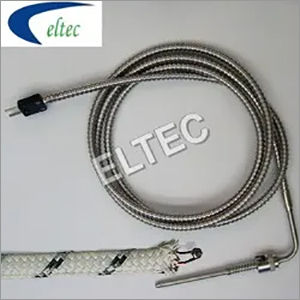
J TYPE thermocouple grade wire is commonly used to build the thermocouple probe. It may also be used to build the sensing point and can be used as a J TYPE THERMOCOUPLE SENSOR or used in manufacturing THERMOCOUPLE ASSEMBLIES or can used to connect to DATA LOGGERS via THERMOCOUPOLE CONNECTORS.
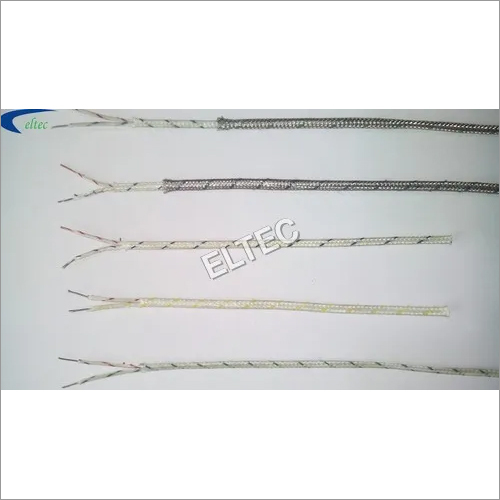
FIBER GLASS INSULATION is ideal for general application requiring moderate abrasion, moisture resistance & high temperature resistance.
| Conductor | Solid or Multi stranded Original THERMOCOUPLE GRADE |
| Core Insulation | FIBER GLASS VARNISHED |
| Core Laying | Parallel or twisted |
| No. of Pair | 1, 2 or more possible |
| Outer Sheath | FIBER GLASS VARNISHED |
| Outer Jacket | Outside SS Metal Braided |
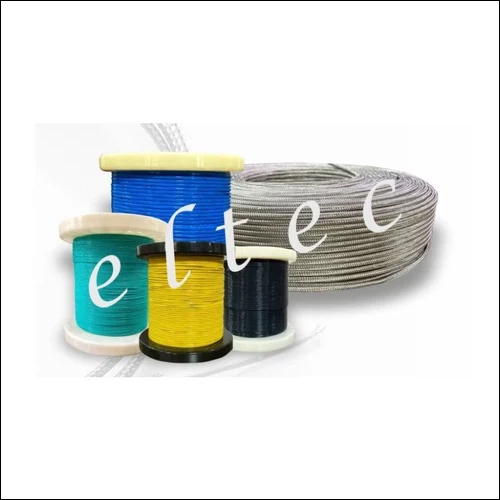
| Color Coding | As per IEC, ANSI, BS, DIN, NFC, JIS etc. Refer table |
| Packing | 100 Mtrs. coil / 500 Mtrs. spool / 1000 Mtrs. drum |
Thermocouple Wire with Fiberglass Insulation Features:
Good thermal durability and tensile strength.
Service temperature up to 180 C with varnish but up to 400 C without varnish.
Good dielectric and electrical characteristics.
Braided fiberglass insulation for abrasion resistance.
Braided fiberglass jacket for additional flexibility and abrasion resistanceDesigned to withstand challenging environments, this thermocouple wire features a high temperature-resistant fiber glass insulation and sheath, providing reliable performance up to 400C. Its solid durability and robust construction make it well-suited for continuous industrial or laboratory use, ensuring safety and accuracy even under demanding conditions.
Precision Temperature SensingAchieve high-precision monitoring with Class 1 accuracy conforming to ANSI MC96.1 standards. The Iron-Constantan (J type) thermocouple combination delivers consistent, dependable readings across a wide temperature spectrum from -40C to 400C. Ideal for applications where accurate thermal measurements are critical to processes or quality control.
FAQs of J TYPE FIBER GLASS THERMOCOUPLE WIRE:
Q: How do I install the J Type Fiber Glass Thermocouple Wire?
A: Installation is straightforward; the wire is designed for easy hand winding and mounting. Simply place the wire where temperature measurement is required, secure it using appropriate fasteners or clamps, and connect the wire ends to your temperature measurement device. No connectors are included, allowing for custom termination as per project requirements.
Q: What applications is this thermocouple wire suitable for?
A: This J type thermocouple wire is mainly used for industrial and laboratory temperature sensing tasks. Its high-temperature resistance and flame-retardant properties make it ideal for furnaces, ovens, manufacturing lines, and research setups where reliable and precise thermal monitoring is crucial.
Q: When should I choose a fiber glass insulated thermocouple wire over other materials?
A: Fiber glass insulation is preferred when operating in environments exceeding the limits of PVC or Teflon, particularly above 200C. This wire is suitable for continuous operation at temperatures up to 400C, making it an excellent choice for high-heat industrial and lab conditions.
Q: Where can I source customized lengths or sizes of this thermocouple wire?
A: Custom lengths, diameters, and packaging options are available directly from the exporter, manufacturer, or supplier in India. Contact the supplier to specify your exact requirements for size, color, and conductor type, ensuring a tailored fit for your application.
Q: What are the benefits of using this unshielded thermocouple wire?
A: Unshielded wires are lighter and more flexible, simplifying installation and routing. The fiber glass insulation provides inherent dielectric strength and thermal protection, while the lack of shielding does not hinder performance for most industrial or laboratory uses where electrical interference is minimal.
Q: How does this thermocouple wire handle voltage surges and high currents?
A: The wire is designed for rated voltages between 110V and 250V and currents up to 2A. It is resistant to voltage surges up to 1500V, offering additional protection in fluctuating environments.
Q: What is the typical process for using this thermocouple wire in temperature measurement?
A: Simply install the wire at the temperature measurement point, connect to the appropriate thermocouple input on your monitoring equipment, and ensure secure mechanical and electrical connections at both ends. The wire will reliably transmit temperature data for process control, safety monitoring, or research analytics.







 Send Email
 Send Inquiry

 Send Inquiry
 Send Inquiry
 Send SMS
 Call Me Free
 English
 Spanish
 French
 German
 Italian
 Chinese (Simplified)
 Japanese
 Korean
 Arabic
 Portuguese