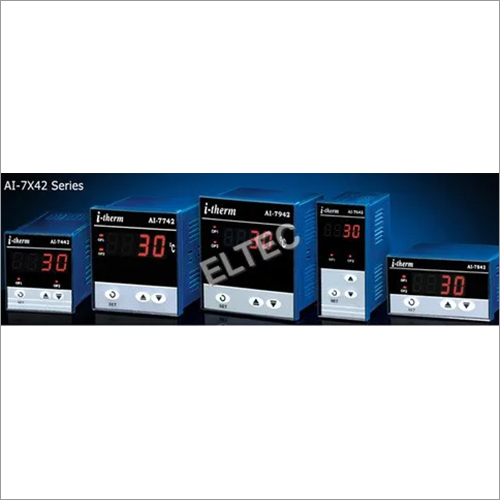
About PID TE,PERATURE CONTROLLER AI-7X42-Series
AI-7X42-Series
Features
- Low cost, Effective, Easy to use PID Temperature Controller
- 4 Digit Single Row Display
- Selectable sensor input (T/C : J,K,R,S & RTD) from keyboard
- Programmable Lower & Upper set point limits
- Programmable control action ON-OFF/PID control
- Programmable hysteresis in ON-OFF mode
- Programmable time delay to activate output in ON-OFF mode
- Selectable heat/cool logic in ON-OFF control mode
- Four different alarm modes (Low/High/Band/Deviation)
- Alarm latch / Alarm inhibit function
- Second output for auxiliary control/alarm mode
- Program lock function (To prevent unauthorized tampering)
- Universal supply voltage ranges from 90 To 270 VAC
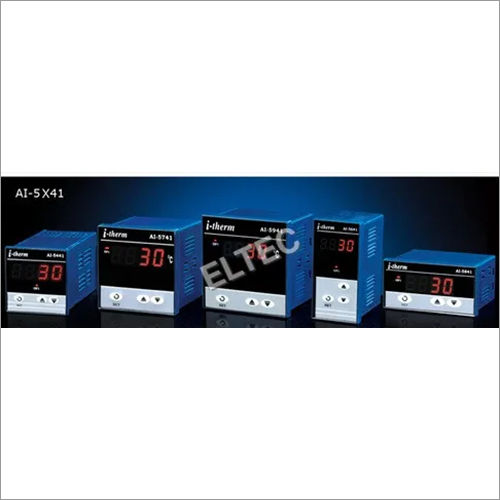
- Available in 5 Standard DIN sizes Specification
Specification
| Series | AI-7X42 |
|---|
| Display |
| Type | 7 Segment LED |
| No. of Digit | 4 Digit Single Row |
| LED Indication | Output Status |
| Display height | Table No.1 |
| Input Specification |
| Measurement |
| Input | Thermocouple J, K, R, S;
RTD: pt-100 |
| Indication Accuracy | 0.3% FS |
| Resolution | J, K, R, S : 1C
RTD : 1C / 0.1 C |
| Output Specification |
| Set Points |
| No. of Set Points | 2 |
| SP Range Limit | J : 0 to 760 C K : -99 to 1200 C
R : 0 to 1700 C
S : 0 to 1700 C
RTD : -100 to 450 C
RTD.1 : -99.9 to 450.0 C |
| Output 1 |
| Relay / SSR Drive | To be Specified (Factory Set) |
| Relay Contact Rating | 5 A @ 250 VAC/30 VDC resistive |
| SSR Drive | 12 VDC @ 50 mA |
| Output 2 |
| Relay / SSR Drive | To be Specified (Factory Set) |
| Relay Contact Rating | 5 A @ 250 VAC/30 VDC resistive |
| SSR Drive | 12 VDC @ 50 mA |
The AI-7X42-Series allows you to select between PID, ON-OFF, or AUTO tuning control methods to optimize temperature management for diverse applications. This flexibility ensures reliable regulation, whether for simple or complex industrial processes.
Wide Input CompatibilityEasily interface with different sensor types, including thermocouples, RTDs, voltage, and current. This universal input capability enables precise temperature measurement across varying equipment setups and industries.
User-Friendly FeaturesEnjoy an intuitive dual 4-digit bright LED display, easy panel mounting, and quick parameter setup. The non-volatile memory safeguards your settings, supporting uninterrupted usage without constant reconfiguration.
Secure and Durable DesignConstructed from ABS flame-retardant material and protected by an IP20 rating, the controller is designed for operational safety and long service life in demanding environments.
FAQs of PID TE,PERATURE CONTROLLER AI-7X42-Series:
Q: How can I select and configure the input type for the AI-7X42-Series controller?
A: To set up the input type, access the controllers parameter menu, where you can choose from thermocouple, RTD, voltage, or current inputs depending on your sensor. Refer to the user manual for the specific codes and configuration steps.
Q: What benefits does auto-tuning offer compared to standard PID or ON-OFF control?
A: Auto-tuning automatically determines optimal PID parameters for your system, reducing manual setup and enhancing control precision. This is especially advantageous when process dynamics are unknown or subject to change.
Q: Where should the AI-7X42-Series controller be installed for optimal performance?
A: Install the controller in a panel-mounted position with sufficient ventilation, away from excessive humidity (3585% RH) and ambient temperatures above 50C. This setup ensures protection against dust and stable operation.
Q: When should I use the alarm feature, and how do I configure it?
A: Use the configurable high/low temperature alarms to alert operators of deviations from set thresholds. Access the alarm settings via the menu and input your desired alarm values as per your process requirements.
Q: What happens to my parameter settings if there is a power outage?
A: The AI-7X42-Series controller employs non-volatile memory, which securely retains all parameter settings even during power loss, eliminating the need to reprogram after outages.
Q: How is the output type (relay, SSR, analog) chosen and what does it influence?
A: Select the output type (relay, SSR, 4-20mA, or 0-10V) during installation or configuration based on your control hardware. The chosen output determines how the controller communicates with your final control element, such as heaters or actuators.







 Send Email
 Send Inquiry

 Send Inquiry
 Send Inquiry
 Send SMS
 English
 Spanish
 French
 German
 Italian
 Chinese (Simplified)
 Japanese
 Korean
 Arabic
 Portuguese